
|
||||||||||||
 |
||||||||||||
|
||||||||||||
 |
||||||||||||
 |
||||||||||||
 |
||||||||||||
|
||||||||||||
|
||||||||||||
|
||||||||||||
|
||||||||||||
|
||||||||||||
|
||||||||||||
|
||||||||||||
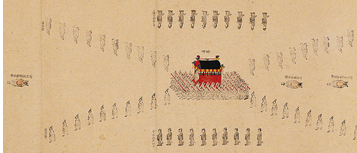
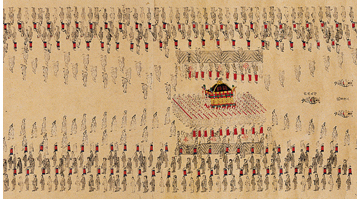
| From the title of 'Sunmyongbi parin pancha-do' (純明妃發引班次圖), it is clear that this is a pancha-do depicting the departure of the funeral procession toward the burial ground at the state funeral of Queen Sunmyong, who had been the consort of King Sunjong in 1904. She was the first consort of King Sunjong (1874-1926) who was the second son of King Kojong. She was from the Yohung Min family, born the daughter of Min T'ae-ho (1834-1884) on October 20 1872 (Year 9 of King Kojong's reign). She had been designated as the crown princess in 1882 at the age of eleven and had been referred to as the 'Great Crown Princess' from 1894 and was designated as the Imperial Princess in 1897. Queen Sunmyong passed away at the age of thirty-three in Kyongun Palace in 1904 before King Sunjong ascended to the throne. A pancha-do for a funeral is one form of pancha-do included in the "Manual of the Superintendency for the State Funeral" (國葬都監儀軌). To examine the main composition of the procession, we have, first of all, the local government officials; the governor of Kynggi Province; deputies of the local police station (當署警務官); the junior officials of Hansng Magistracy (漢城府主事); judges of Hansong Magistracy (漢城府判事); and deputies of the Department of Police (警務廳 警務官) who make up the front part of the procession. When the soldiers and the band have passed, the small sedan-chair carrying the order of appointment and the stamp of appointment which Queen Sunmyong had received at the time of the wedding ceremony in 1882; the small sedan-chair carrying the appointment address and royal gifts which she had received upon designation as the Imperial Princess in 1897; and the small sedan-chair carrying the posthumous title and royal stamp of that title pass by in turn. The band surrounds the Royal Sedan-chairs, and the Director of Superintendency for Embalming (殯殿都監堂上) is following behind. The sedans for carrying the various vessels in the royal court for memorial ceremonies of the deceased and sedans for carrying royal objects such as dresses and treasures follow at the rear. The carriages carrying Pang Sang-ssi (方相氏; a symbolic creature believed to send evil spirits away), the chuksanma (竹散馬; a bamboo horse used in funerals for the royal family) and chukanma (竹鞍馬; a bamboo horse with a saddle, used in funerals for the royal family) can be seen as well. Furthermore, the officials above the third rank of the Superintendency for the State Funeral are following the small sedan-chair of funeral oration and the kyonyo (肩輿; a simple burial bier); and lamenters composed of sixteen women on horseback are passing by surrounded by white screens all around them. Myongjong (銘旌; ribbon on which profile of the dead is written) and the huge burial bier which were the main parts of this procession take up the rear of the procession; and officials from five police stations under the Department of Police, chief supervisor of state funerals (摠護使), and the junior officials of the Bureau of State Ceremony (掌禮院主事) follow. Since there are more people mobilized for the funeral in this pancha-do than in any other section, it is a scene which provides a grand spectacle. The people and horses exhibit almost no motion, lack the feeling of movement, and the outlines of the wood-cut printing are comparatively blunt and dull, characteristics which appear commonly with pancha-do after the late-nineteenth century. Since 1904 falls within the age of the Korean Empire, soldiers are depicted dressed in black western suits according to the reorganization of the government system, and the titles of new government offices such as Department of Police (警務廳) and the Bureau of State Ceremony (掌禮院) appear as well. "Manual of Superintendency for the State Funeral (of Queen Sunmyong)" ((純明王后)國葬都監儀軌), the manual of this state funeral, is in the possession of Kyujanggak at Seoul National University. | ||||||||||||








 |

